

Notion is an all-in-one workspace application: I take notes, write documents, manage projects and store data in the same place, on pages made up of content blocks and databases that can be viewed in multiple formats. According to Notion's official pricing page (checked on 23/10/2026), the Free plan costs $0 and is available for individuals, and currently includes an AI assistant and agents that automate repetitive tasks. For small business owners, for example, Notion replaces scattered spreadsheets, notes scattered everywhere and separate project management tools with a unified system. This article covers: (1) pages and blocks; (2) databases; (3) pricing; (4) how to set up in 30 minutes; (5) AI and agents; (6) how to connect Notion with n8n, Zapier, Make and MCP.
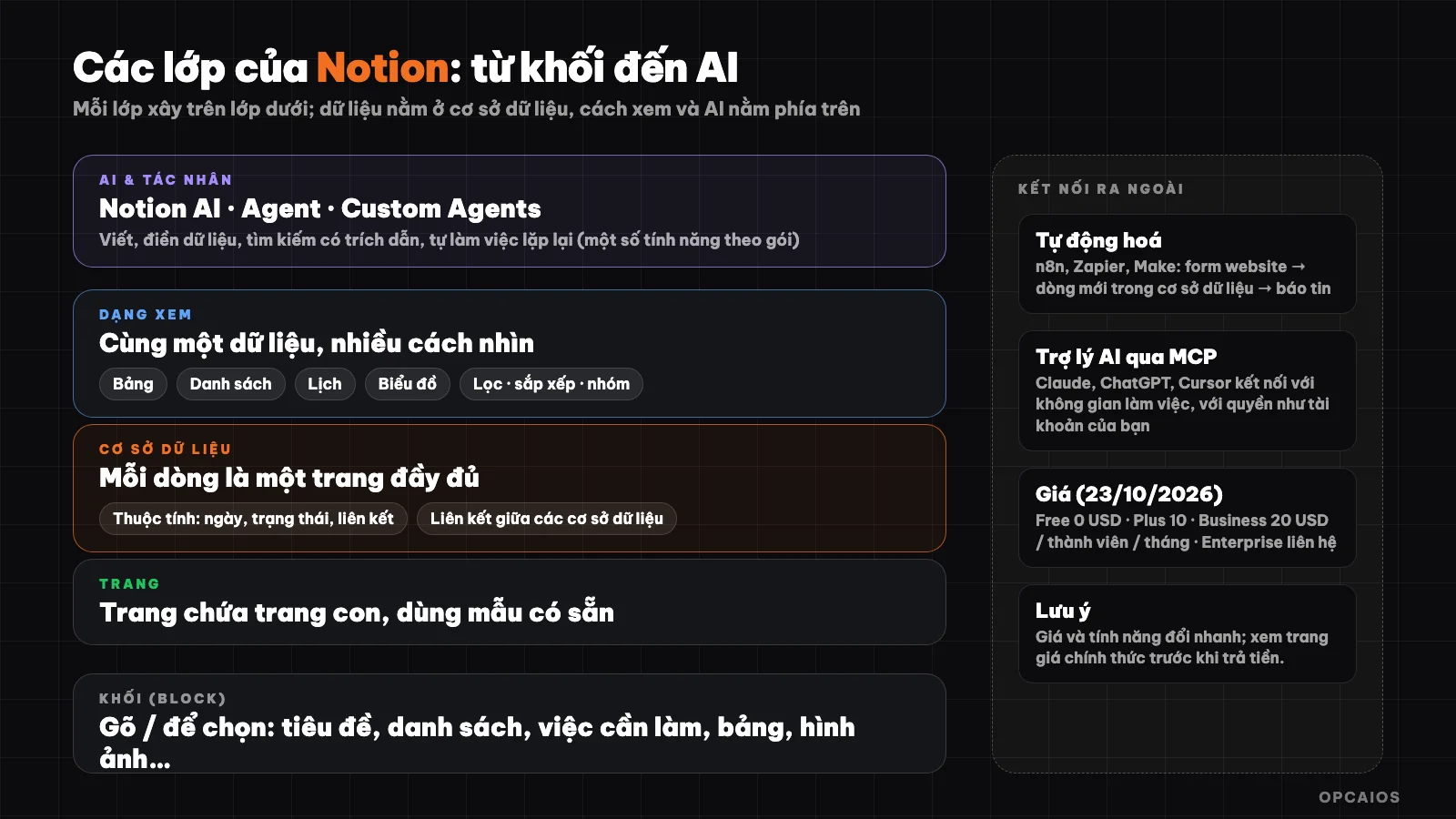
Notion's layers from bottom to top: blocks, pages, databases, view types, then AI and automation. Diagram: OPCAIOS.
What is Notion?
Notion is a workspace that combines notes, documents, project management and databases in one place. The official homepage describes Notion as "an AI workspace that works for you" with three main functions: (1) consolidate knowledge into a single system; (2) find answers instantly with source citations; (3) automate repetitive work with AI agents running continuously.
According to figures Notion self-reports on its homepage (checked on 23/10/2026), the application has over 100 million users in over 50 countries and is used by more than half the companies in the YC program; OPCAIOS has not independently verified these numbers. Notion runs on web, desktop and mobile, and has its own calendar called Notion Calendar. What makes Notion different from a regular note-taking app is three things: all content is draggable blocks, data lives in databases rather than separate spreadsheets, and there are multiple ways to view the same data.
How do pages and blocks work in Notion?
Pages are the basic unit of Notion, and each page is made up of blocks. According to the description on the official pricing page, a block is each piece of content you add to a page, like a to-do checkbox, a paragraph, a list item. Type a slash / on an empty line to choose a block type: heading, list, table, image, database and many others.
Pages can contain subpages, so you can build a document tree: a "Company" page contains a "Process" page, which contains a "Customer Care" page. Templates help you get started quickly: instead of starting from a blank page, you copy a project management or content calendar template and adjust it to your needs.
What is a database in Notion?
A database is a data table where each row is a full page. According to Notion's official help center (checked on 23/10/2026), a database has three characteristics: each item is a separate page you open to add text, images; each item has custom properties like date, status, link; and data can be viewed in multiple formats like table, list, calendar or chart.
Example: a "To-do" database has Status, Deadline and Owner properties. With that same data, you view it as a table to review, as a calendar to see deadlines, and filter by owner so each person only sees their work. Notion also lets you link databases together, for instance combining contacts, companies and sales opportunities into a CRM.
To create a database, create a new page and select Table, or type /database in an existing page. It displays as a table by default, but you can add as many views as you want. When creating, Notion also lets you ask AI to build a database from a description.
What is Notion's current pricing?
Notion has a free plan and three paid plans. According to Notion's official pricing page (checked on 23/10/2026), pricing is per member per month: Free plan $0 for individuals, Plus plan $10 for small teams and professionals, Business plan $20 for growing businesses, and Enterprise plan contact for details. Annual billing saves up to 20%. Custom Agents has a free trial, then costs $10 for every 1,000 Notion "credits" per month. In example scenarios: a solo user typically gets by with the Free plan, while a team of 5 needing 30-day page history and unlimited file uploads could choose Plus. The Free plan limits file uploads to 5 MB maximum and outside guests to 10 maximum, while the Business plan at $20 adds Notion Agent, single sign-on (SSO), and 90-day page history. A sensible order to consider is trying Free first, then Plus as your team grows, and finally Business when you need detailed permissions. Prices and limits change over time, so check the official pricing page before deciding.
Notion pricing table and plan limits
| Plan | Price | For | Key points |
|---|---|---|---|
| Free | $0 | Individuals | Unlimited pages and blocks for one person, limited with multiple members; file uploads capped at 5 MB; 7-day page history; outside guests capped at 10; AI trial access |
| Plus | $10 | Small teams and professionals | Unlimited file uploads, 30-day page history, unlimited guests |
| Business | $20 | Growing businesses | Notion Agent, AI meeting notes, single sign-on (SSO), row-level permissions, 90-day page history |
| Enterprise | Contact | Large organizations | Unlimited page history and admin controls, advanced security |
How to set up Notion in 30 minutes
You can build a streamlined work system in 30 minutes following six steps below, using Notion's Free plan at $0 (checked on 23/10/2026):
- Step 1, create a home page named "Hub" as an entry point, pin it to the top of the sidebar.
- Step 2, create a "Tasks" database: add Status property (Not started, In progress, Done), Due date, Assignee.
- Step 3, add two views: a table to review and a calendar to track deadlines.
- Step 4, create a second database for what you manage most, for example "Customers" or "Content".
- Step 5, link the two databases so each task ties to a customer or a piece of content.
- Step 6, embed both into the home page as filtered views, so opening Notion shows today's work right away.
Principle to keep the system durable: few databases but use them for real, name pages clearly, and tidy up every week. A complex system nobody updates is worse than a simple list used every day.
How do small businesses in Vietnam use Notion?
Three common uses, all built with databases and the Free or Plus plan:
- Small CRM: "Customers" database with Source, Status, Last contact date properties; add a view by status to see which stage each customer is at in your sales process.
- Content calendar: each post or video is a page with Channel, Publish date, Assignee, and Review status properties; view as a calendar to spread posts evenly across weeks.
- Process wiki: instruction pages (how to quote, how to handle complaints) so new staff can look things up themselves instead of asking everyone.
If you work alone and are unsure which task to automate first, read more at What should solo workers automate first?.
What Can Notion AI and Agents Do?
Notion AI is a set of AI features built right into your workspace, helping you write content, fill database records, search, and automate repetitive work. According to Notion's official product page (checked on 23/10/2026), there are five feature groups:
- 1. Try AI is available on Free and Plus plans (create documents, auto-fill databases).
- 2. Notion Agent (Business plan) completes multi-step tasks based on context from Notion, connected apps, and the web.
- 3. Custom Agents are self-running agents for repetitive work, available free to try then charged at $10 per 1,000 Notion credits monthly according to their pricing page.
- 4. AI meeting notes and search across connected apps like Slack, GitHub (enterprise search is in beta).
- 5. Page verification: badges for pages kept up to date, shown in search results and AI citations.
AI features and their plans change quickly, so check the product page before paying for a specific feature. When letting AI read company data, review Notion's permissions and privacy settings first.
How Do I Connect Notion with Automation Tools and AI Assistants?
Notion connects to other tools in two directions, and Notion officially supports both. The first direction is connecting with automation tools. Tools like n8n, Zapier, and Make have Notion integrations, so you can build workflows like: when a new contact form comes in on your website, add a row to Notion's "Customers" database and notify your team. Data from your website goes through webhooks; see the post What is a webhook?.
The second direction is connecting with AI assistants via MCP. Notion has an MCP server that lets AI apps like Claude, ChatGPT, or Cursor connect to your workspace. According to Notion's help center (checked on 23/10/2026), the MCP tool acts with full permissions of your account, meaning it can access everything you can access. Notion recommends starting with personal use and using clear page titles so AI understands the structure. Enterprise plan admins can choose which AI apps are allowed to connect. More about MCP in the post What is MCP?.
Notion or Obsidian: Which Should I Choose?
Choose Notion when you need team collaboration, databases, and multiple views in the cloud; choose Obsidian when you want Markdown notes stored right on your computer and full control of your files. The two tools solve different needs, and many people use both: Notion for team work and projects, Obsidian for personal knowledge.
Notion is not a good choice when you need data entirely on your own machine, when your team just needs a simple to-do list, or when you have complex automation workflows—in those cases a dedicated tool like n8n is better.
Read more: 5 best second brain tools 2026.
Frequently Asked Questions
What is Notion and what is it used for?
Notion is an all-in-one workspace used for note-taking, writing documents, managing projects, and building databases like CRMs or content calendars. Content is organized using pages, blocks, and databases with multiple view types.
Is Notion free?
Yes. According to Notion's official pricing page (checked 23/10/2026), the Free plan for individuals costs $0. The Free plan limits file uploads to a maximum of 5 MB, page history to 7 days, and outside guests to a maximum of 10. The Plus plan costs $10 and the Business plan costs $20 per member per month, with annual billing saving up to 20%. Step 1, try the Free plan. Step 2, upgrade to Plus when needed. The Plus plan extends page history to 30 days and removes file upload limits, while the Business plan offers 90 days of page history. For example (hypothetically), a solo freelancer typically only needs the Free plan, while a 5-person team that needs to review edit history over longer periods should consider the Plus plan. Check the official pricing page for current rates.
How do databases in Notion differ from spreadsheets?
Each row in a Notion database is a full page that can contain text and images. The same data can be viewed as a table, calendar, list, or chart, and databases can be linked to each other.
Is Notion AI free?
The Free and Plus plans can trial AI features like document creation and database auto-fill. Notion Agent is part of the Business plan, while Custom Agents are free to try then charged by credit. Check the pricing page for current details.
Where can I learn Notion quickly?
Start with a "To-Do" database as shown in the guide above, use Notion's built-in templates, and read the official help center. To build a work system and AI workflows for a small team, see OPCAIOS's AI application training course.
Source: Notion's official homepage, pricing page, and help center along with Notion MCP documentation (checked 23/10/2026). Prices, limits, and features may change; user numbers are self-reported by Notion.
Translated from Vietnamese with AI. Read the original.
Want to apply this in your business?
Book a free 30-minute call (Vietnam time, in English or Vietnamese).