

What is Content Marketing?
Content marketing (marketing through content) is a strategic marketing approach that focuses on creating and distributing valuable, relevant, and consistent content to attract and retain a clearly defined audience, and ultimately drive profitable action from customers. The above definition comes from the Content Marketing Institute (CMI), an organization specializing in this field. This article is updated for 2026 and contains four main sections, read in the following order:
- A brief history, formats, and a one-page strategy.
- Google's "helpful content, people first" standard.
- Google's policy on AI-generated content, or scaled content abuse.
- A six-step process for small businesses and OPCAIOS's experience using AI to write blogs.
For example, a small shop can start with one page answering the most frequently asked customer questions, then expand from there.
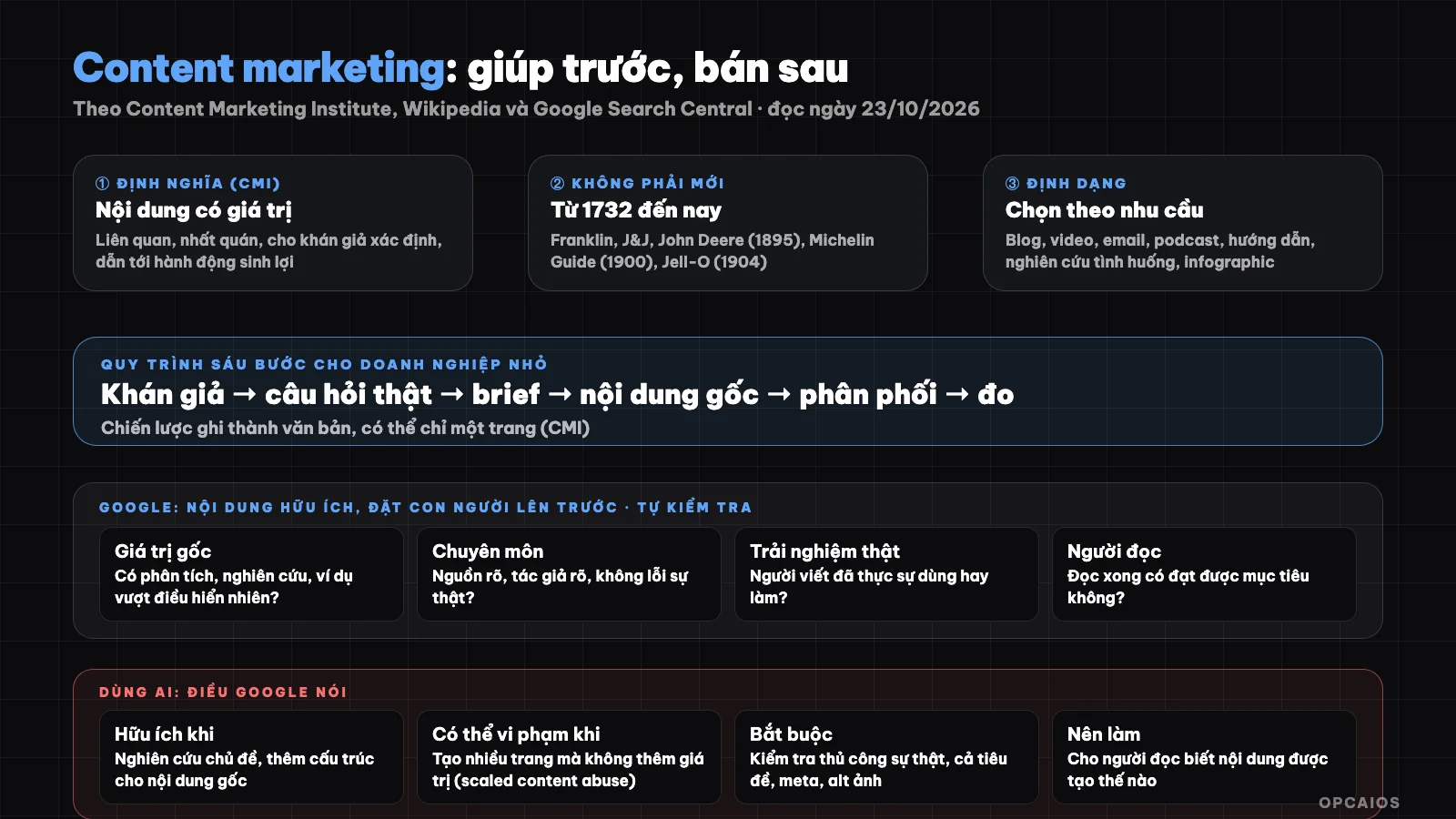
Content marketing goes from audience to valuable content, then distribution and measurement. Diagram: OPCAIOS.
What is Content marketing?
According to CMI, instead of promoting a product or service, the content-based approach provides relevant and useful information to help potential customers and customers solve problems at work (B2B content) or in personal life (B2C content). CMI emphasizes that you must have a written strategy, and the phrase "relevant and valuable" is what distinguishes strategic content from the information spam of companies that "sell first, help later."
According to Wikipedia, content marketing is a form of marketing focused on creating, publishing, and distributing content to a target audience online, usually aimed at: attracting attention and generating leads, expanding the customer base, increasing online sales, building brand awareness or credibility, and engaging community. It starts with identifying customer needs, then choosing a format.
CMI states that quality content is a part of all other forms of marketing such as email, social media, SEO, public relations, cost-per-click advertising, inbound marketing, and digital marketing; it should not be seen as separate. They list four benefits of doing excellent content: increased sales, reduced costs, better and more loyal customers, and revenue coming from the content itself.
What is the history of content marketing?
Content marketing is not an invention of the Internet era. According to Wikipedia, businesses have used it since the late 19th century:
| Year | Who | What they did |
|---|---|---|
| 1732 | Benjamin Franklin | Published Poor Richard's Almanack to promote his printing business |
| 1888 | Johnson & Johnson | A guide publication on antiseptic wound treatment for doctors |
| 1895 | John Deere | The Furrow magazine for farmers on how to run a profitable business, considered the first custom publication |
| 1900 | Michelin | Michelin Guide providing information on vehicle maintenance, accommodations, and travel tips |
| 1904 | Jell-O | Sales staff distributed free cookbooks door-to-door |
The term "content marketing" has been used at least since 1996, according to Wikipedia. When social media emerged in the late 2000s, online content became easier to share and available at any time.
What content can be used for content marketing?
There are many formats, from long to short. Wikipedia lists: news, video, white papers, e-books, infographics, email newsletters, case studies, podcasts, how-to guides, Q&A articles, photos, and blogs. Short content includes short blog posts and social media posts. What matters is choosing the format based on your audience's needs, not based on what is trending.
What does a content marketing strategy include?
A good strategy answers five questions and fits on one page, as CMI suggests with the "one-page strategy":
- Who is your audience and what problem do they need to solve? Without a defined audience, there is no valuable content.
- What do you want them to do? Business goal: sign up, ask for consultation, make a purchase.
- What content do you help them with, and in what format? Choose a few topics you truly have expertise in.
- Where do you distribute it? Website, email, social media, partners.
- How do you measure it? According to Wikipedia, beyond e-commerce metrics like click-to-checkout rate, you should look at engagement metrics like time on page, number of product page views per user, and return rate.
What Google Means by "Helpful, People-First Content"
Helpful, people-first content is content created primarily for readers, not to manipulate search rankings. Google's automated ranking system, according to Google, prioritizes information that is helpful and trustworthy, created to benefit users (Google Search Central, accessed 23/10/2026). What follows are five groups of questions that Google suggests you ask yourself to evaluate an article before publishing, for example with a five-page piece:
- Value: does the article contain original information, research, or analysis, and does it add significant value rather than just copying from other sources?
- Headline: does the headline summarize helpfully, without exaggeration or sensationalism?
- Expertise: does the article have clear sources, author information, and are there easily verifiable factual errors?
- First-hand experience: does the article demonstrate real-world experience, such as having used the product or service?
- Reader: after reading, does the reader feel they have learned enough to achieve their goal?
What signs indicate content is made only for search engines?
"Search engine-first content," according to Google, is content created primarily to attract search traffic rather than help readers. Google's Search Central page lists five warning signs, accessed 23/10/2026. First, writing many pieces about diverse topics hoping a few will rank. Second, using widespread automation to create content on many topics. Third, only summarizing what others have said without adding value. Fourth, writing about trending topics even if unrelated to your site's audience. Finally, writing to a specific word count because you heard Google prefers certain word counts, when Google has stated there is no ideal word count. For example, a hypothetical home goods store suddenly publishing 30 pieces about cryptocurrency just because the topic is trending would be a textbook case of the fourth warning sign.
Does Using AI to Write Content Violate Google's Guidelines?
Using AI to write content does not automatically violate Google's guidelines; what is considered a violation is large-scale abuse of content (scaled content abuse). Google's guidelines on AI-generated content, from Search Central, accessed 23/10/2026, state that AI is particularly useful when researching a topic and adding structure to original content. However, creating many pages with AI without adding value to users can violate Google's spam policy, according to Google, regardless of how the content was created. Google then recommends three things you should do:
- Check for accuracy: language models predict word sequences; they don't retrieve facts, so they can fabricate (hallucinate); you need to verify manually before publishing.
- Check metadata: title tags, meta descriptions, structured data, and image alt text.
- Give readers context: clearly state how content was created if you used automation.
For example, an 800-word draft written in Claude still needs a person to verify each statistic and proper noun before publishing.
Six-Step Content Marketing Process for Small Business
- Choose your audience and goal: one customer group, one action you want them to take.
- Take topics from real questions: questions your customers ask via chat, email, consultation calls; repeated questions are the best topics.
- Write a brief and gather sources: the article's goal, who reads it, official sources you need to cite, what this piece offers that others don't.
- Create content with original value: a real example, a statistic with a source, a diagram or template you can use right away. AI can help with research and drafting, but you must verify the facts.
- Distribute: publish on your website, send to subscribers, share where your audience is.
- Measure and update: see which articles are read, which lead to action; update old pieces instead of only writing new ones.
Common Content Marketing Mistakes
- Sell first, help later: content is just disguised advertising, exactly what CMI calls information spam.
- No defined audience: writing for "everyone" means writing for no one.
- Chasing keywords, word counts, or trends: Google has clearly named these as warning signs.
- Publishing a lot without fact-checking: especially dangerous when using AI.
- Not measuring: if you don't know which pieces work, you can't improve.
OPCAIOS's Experience with AI-Powered Blogging
I use AI to research and draft the posts on this blog, so I've set rules that follow Google's spirit: each post must be checked against official pages or primary documents; unverified data is clearly marked as "unverified"; when a page blocks automated access, I don't bypass it but note it clearly; each post has its own diagram; and every post goes through the website owner's review before being scheduled. The website also has an SEO scoring tool and a measure of how easily AI can cite it (GEO) for each post. I don't claim these posts will rank high; this is a process to maintain quality as speed increases. If you're interested in how to work with AI in marketing, see What is vibe marketing? and What is growth hacking?.
Which tools support content marketing?
You don't need many tools to get started: a place to publish, an email tool, a spreadsheet to track topics and metrics. As you grow, you can connect steps using n8n, Make, or Zapier, and manage leads with a CRM like HubSpot. With AI, choose a model by task as in Which AI model should I choose?.
Frequently Asked Questions
What is content marketing?
It's a strategic marketing approach that creates and distributes valuable, relevant, and consistent content to attract and retain a defined audience, and ultimately drive profitable customer action (according to the Content Marketing Institute).
How is content marketing different from advertising?
Instead of selling products, content marketing provides useful content that helps customers solve problems, then builds trust and willingness to buy later. Content that only "sells first, helps later" is considered spam by CMI.
Will Google penalize me for using AI to write content?
Google says using AI doesn't automatically violate policy, but creating many pages with AI without adding value to users may violate scaled content abuse policy. You need to fact-check all AI-generated content, including metadata.
What does a content marketing strategy need?
Your audience and their problems, business goals, topics and formats, distribution channels, and how to measure. CMI recommends writing it down, even if just on one page.
Where should a small business start?
From the questions customers ask most: answer them with content that includes real examples and clear sources, measure results, then expand. To learn how to use AI for this safely, see OPCAIOS's AI application training course.
Sources: Content Marketing Institute's "What is content marketing" page; Wikipedia "Content marketing" (history, formats, metrics); Google Search Central: "Creating helpful, reliable, people-first content", "Google Search's guidance on using generative AI content on your website" and spam policy (scaled content abuse); read directly on 23/10/2026. Process experience is OPCAIOS's, without performance metrics. Not legal advice or ranking guarantee.
Translated from Vietnamese with AI. Read the original.
Want to apply this in your business?
Book a free 30-minute call (Vietnam time, in English or Vietnamese).