

What is HubSpot?
HubSpot is a customer relationship management (CRM) platform that combines marketing, sales, and customer service into one unified data system. What makes HubSpot popular with small businesses is its free CRM plan: according to the official website (checked 23/10/2026), this plan is free for up to two users and 1,000 contacts, with no time limit. This 2026 update includes four parts:
- What HubSpot does, the free plan, and paid plans ranging from $15 to $75 per seat per month.
- How to connect via API, webhook, and MCP.
- When a business should build its own CRM like OPCAIOS did.
- General considerations when choosing any CRM.
For example, a 2-person team logging customers into a spreadsheet can switch to the Free plan without spending money.
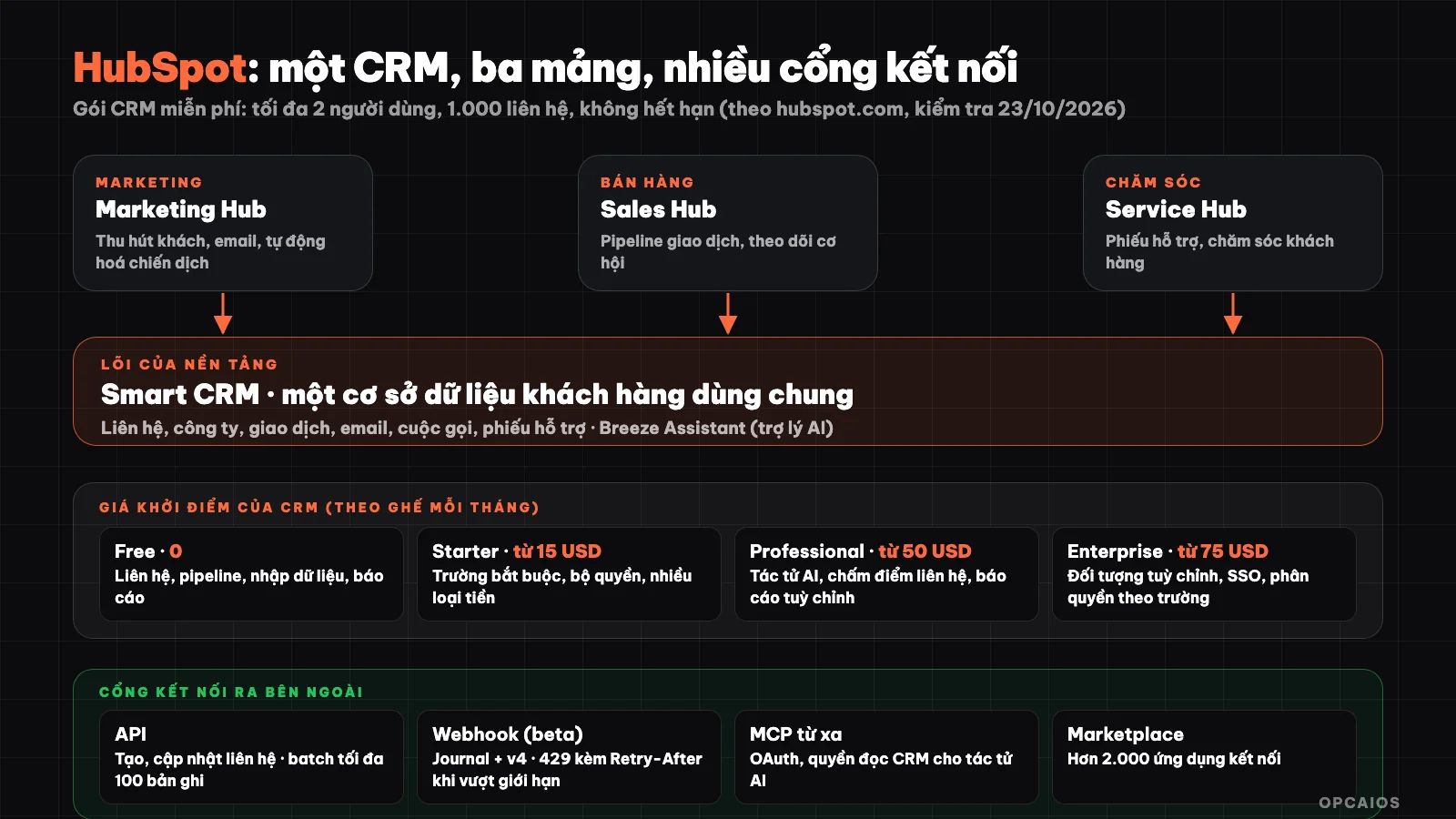
HubSpot brings three areas around one customer database, and opens outward through API, webhook, MCP. Diagram: OPCAIOS.
What is HubSpot?
HubSpot is a Customer Platform with CRM at its core, where marketing, sales, and customer service teams work together on one dataset. HubSpot's homepage describes it as an agentic AI platform for all three areas. The CRM here is a database storing every customer interaction: contacts, companies, deals, emails, calls, and support tickets. HubSpot Marketplace, according to HubSpot (CRM page, checked 23/10/2026), has over 2,000 connected apps. The homepage lists main products, starting with Smart CRM, followed by Hubs by area and AI tools:
- Smart CRM: AI-powered CRM, the core of the entire platform.
- Marketing Hub, Sales Hub, Service Hub: attract customers and automate campaigns, manage pipelines, manage support tickets.
- Content Hub, Data Hub, Revenue Hub: content, data, and revenue.
- Agent Hub and Breeze Assistant: build AI agents and AI assistants within CRM.
- Small Business Bundle: Starter versions of each product, for small businesses.
For example, a 5-person shop can start with just the free Smart CRM and add Sales Hub when needed to manage pipelines.
What does the free HubSpot CRM include?
The free HubSpot CRM is a plan that lets you use a real CRM, not just a trial. You get, according to HubSpot (CRM page, checked 23/10/2026), up to two users, 1,000 contacts, and unlimited customer data, completely free with no expiration date. The Free plan has five standout features:
- Contact management.
- Deal pipelines.
- CRM import.
- Breeze Assistant, an AI assistant.
- Reporting dashboard.
HubSpot makes clear you can upgrade from the free plan to a paid plan without moving your data, so this approach is good for testing with real data before spending money. Also, the two-user and 1,000-contact limits are hard caps on the plan. For example, a 3-person sales team or a list of 5,000 customers would need to pay.
How much does HubSpot CRM cost?
HubSpot CRM pricing is per seat per month, increasing with each plan. According to the official CRM page (checked 23/10/2026), the starting price for each plan is:
- Free: $0. Contacts, deal pipelines, data import, basic reporting, Breeze Assistant.
- Starter: from $15 per seat per month. Everything in Free, plus required fields, permissions, multiple currencies, remove HubSpot branding. Starter pricing has a special offer only for new customers; HubSpot notes the offer has no fixed end date and may stop at any time.
- Professional: from $50 per seat per month. Add AI customer care agent, duplicate management, contact scoring, calculated attributes, custom reporting.
- Enterprise: from $75 per seat per month. Add custom objects, team organization, single sign-on (SSO), field-level permissions.
These are the starting prices for CRM alone. Hubs like Marketing, Sales, or Service have their own pricing tables, and the detailed pricing page displays via JavaScript so this post doesn't include numbers for each Hub. For example, a 4-person team on the Professional plan starts at 4 × $50 = $200 per month. Check the official pricing page for your account and region before deciding.
When should you use HubSpot?
HubSpot works well for businesses that want a CRM that runs out of the box, requires minimal coding, and is ready to pay per seat as they grow. A few real-world situations:
- Just starting to track customers: currently recording customers in spreadsheets, want a pipeline and reminders. The Free plan is enough to try.
- Small sales team: need to assign customers by person, measure pipeline, attach emails to customer records.
- Want to scale gradually: have a ready roadmap from Starter to Enterprise without changing systems.
On the other hand, think carefully if you have very specific sales processes (for example, matching bank transfer payments to orders), a large team (per-seat costs add up fast), or want to keep all customer data on your own infrastructure.
How do you connect HubSpot via API and webhooks?
HubSpot has a public API to create, read, and update CRM data from other systems. According to the developer documentation for the Contacts API:
- When creating a contact, you send properties like
email,firstname,lastnamein thepropertiessection. - Batch operations are limited to 100 records per request.
- You can update by an identifier property (
idProperty), for example using email as the key. The documentation notes that if you use email asidProperty, partial upsert is not supported; to do that you need a unique custom identifier property.
For webhooks, the current documentation has guides for Webhooks journal and the v4 subscription API in BETA form, not compatible with the old v3 webhooks. Journal lets applications subscribe to receive events in real time, replay old event data, and take snapshots of CRM record state. Key points:
- Scope-based permissions: for example, to receive contact events you need
crm.contacts.readscope, plus management permissions likedeveloper.webhooks_journal.read. - Rate limits: subscription API 50 requests per second per application, snapshot API 10 requests per second. Exceeding the limit returns code 429 with a
Retry-Afterheader. The documentation notes these limits may change during beta. - Sequential processing: process journal files in time order using offset, save
currentOffsetfrom the response; journal file paths expire after a time so you need to download them promptly. - Retry with backoff: use exponential backoff for temporary errors and rate limit errors.
If you're new to the concept, read What is a webhook? and What is an API?. The handling pattern here is like any other gateway: authenticate, remember where you left off, retry with backoff.
How does HubSpot connect with AI via MCP?
The HubSpot MCP server is a gateway for AI tools to read and write CRM data, and HubSpot provides two kinds. According to the official documentation (checked 23/10/2026):
- Remote server allows AI tools or compatible MCP agents, like Claude (Anthropic), to read and write CRM data (contacts, deals, interactions).
- Developer server (runs locally) helps AI programming tools work with the HubSpot development platform via command line.
To use the remote server, first you create a user-scoped application on HubSpot's new development platform. Next, grant read permissions to the CRM objects you need to access. Finally, use the OAuth credentials to connect to the address mcp.hubspot.com via any MCP client. The documentation states the server supports OAuth 2.0 and will transition to require OAuth 2.1 (with PKCE and refresh token rotation after each use).
Example commands in the documentation: summarize deals at a pipeline stage with value over $1,000, or summarize the five most recent support tickets for a customer. Safety advice as with any MCP: start with read permissions, test on non-critical data, and keep manual review before any write operations. See more at What is MCP?.
When Should I Build a Custom CRM Instead of Using HubSpot?
Building a custom CRM makes sense when your processes are unique and you already have a website and your own database. This is OPCAIOS's real experience: opcaios.org doesn't use HubSpot but built a custom CRM within the same database. The self-built system has four parts:
- Customer intake.
- Tasks and SLA deadlines.
- Payments and customer sources.
- Zalo and Messenger inboxes.
The reason is that domestic bank transfers, customer sources from domestic social media, and order data already live in the website, so connecting them to a custom CRM is simpler than syncing to an external system like HubSpot. This is a choice for OPCAIOS's scale, not a general recommendation.
A comparison of directions, not a quality assessment:
| Criteria | HubSpot | Custom CRM |
|---|---|---|
| Time to start | Minutes with Free plan | Weeks to months |
| Cost | Free to per-seat pricing | Development and maintenance costs |
| Custom processes | Pre-built configuration, extended via API | Fully flexible |
| Data | Hosted on HubSpot's platform | Hosted on your infrastructure |
| Maintenance | HubSpot handles it | You handle it |
Many businesses start with HubSpot Free, measure what they actually need, then only build custom when the requirements are clear. If you already have data in your own database like Supabase, syncing both ways via Make, n8n, or Zapier is also an option.
Things to Keep in Mind When Using HubSpot or Any CRM
- Start with process, not tools: map out the steps from getting a customer to collecting payment before configuring anything.
- Clean data matters more than features: standardize how you write names, phone numbers, and customer sources from the start; duplicates are the common cause of wrong reports.
- Personal data: CRM contains your customers' personal information; collect only what's needed, set permissions by role, and comply with current personal data protection rules.
- Check limits and pricing carefully: Free plans have caps on users and contacts, per-seat pricing changes over time; read the official pricing page.
- Lock down API keys and OAuth: grant minimum permissions to each app, don't store keys in code running in the browser.
Read more: Best CRM for Small Businesses 2026, 5 Best Email Marketing Tools 2026 for Small Shops.
Frequently Asked Questions
What is HubSpot?
HubSpot is a customer platform with CRM at its core, bringing together marketing, sales, and customer service into one data system. It has a free CRM plan and paid plans priced per seat.
Is HubSpot CRM free?
Yes. According to the official site (checked 23/10/2026), the free CRM is for up to two users and 1,000 contacts, with no limits on customer data and no expiration date. Going beyond those limits requires upgrading to a paid plan.
How much does HubSpot CRM cost?
According to the official CRM pricing page (checked 23/10/2026), the starting price is $15 per seat per month for Starter (with new customer discounts), $50 for Professional, and $75 for Enterprise; the Free plan is $0 for up to two users. The other Hubs like Marketing, Sales, and Service have separate pricing tables, so check the pricing page. First, start with Free to measure real needs. Next, only upgrade when you exceed 2 users or 1,000 contacts. Finally, compare total per-seat cost with the cost of building your own. For example, a team of 3 on Starter costs around 3 × $15 = $45 per month, not counting other Hubs.
Can HubSpot connect with AI and automation tools?
Yes. HubSpot has a public API, webhooks (journal and v4 in beta), over 2,000 apps in the Marketplace, and an MCP server for AI agents to read CRM data via OAuth. You can also connect via Make, n8n, or Zapier.
When should I build a custom CRM instead of using HubSpot?
When your processes are unique, data already lives in your own systems, and you have someone to maintain it. OPCAIOS built a custom CRM on its website. To design customer workflows and automate for small business, check out OPCAIOS's AI application training course.
Source: official site, CRM page, and official developer documentation from HubSpot (contact API, webhooks journal v4, MCP; checked 23/10/2026); OPCAIOS's experience building a custom CRM. Prices, limits, and features may change; pricing for each Hub is not included in this post because the pricing page cannot be read automatically.
Translated from Vietnamese with AI. Read the original.
Want to apply this in your business?
Book a free 30-minute call (Vietnam time, in English or Vietnamese).