

Email marketing là gì? Email marketing là việc gửi thông điệp thương mại, thường cho một nhóm người, qua email để chăm sóc khách hàng hiện tại và cũ, khuyến khích mua lại, thu hút khách mới hoặc thuyết phục mua ngay. Phần khó của email marketing ngày nay không còn là viết tiêu đề hay mà là bảo đảm thư vào được hộp thư đến và đúng luật: từ 1/2/2024 Gmail và Yahoo, theo hướng dẫn của Google (đọc ngày 23/10/2026), yêu cầu người gửi xác thực tên miền, giữ tỉ lệ báo thư rác dưới 0,3% và (với người gửi nhiều) hỗ trợ huỷ đăng ký một chạm. Còn ở Việt Nam, Nghị định 91/2020/NĐ-CP quy định riêng về email quảng cáo: phải có sự đồng ý trước, gắn nhãn [QC] hoặc [AD], có chức năng từ chối nhận. Bài này tổng hợp các yêu cầu đó từ văn bản gốc và hướng dẫn chính thức, kèm quy trình thực hành cho doanh nghiệp nhỏ.
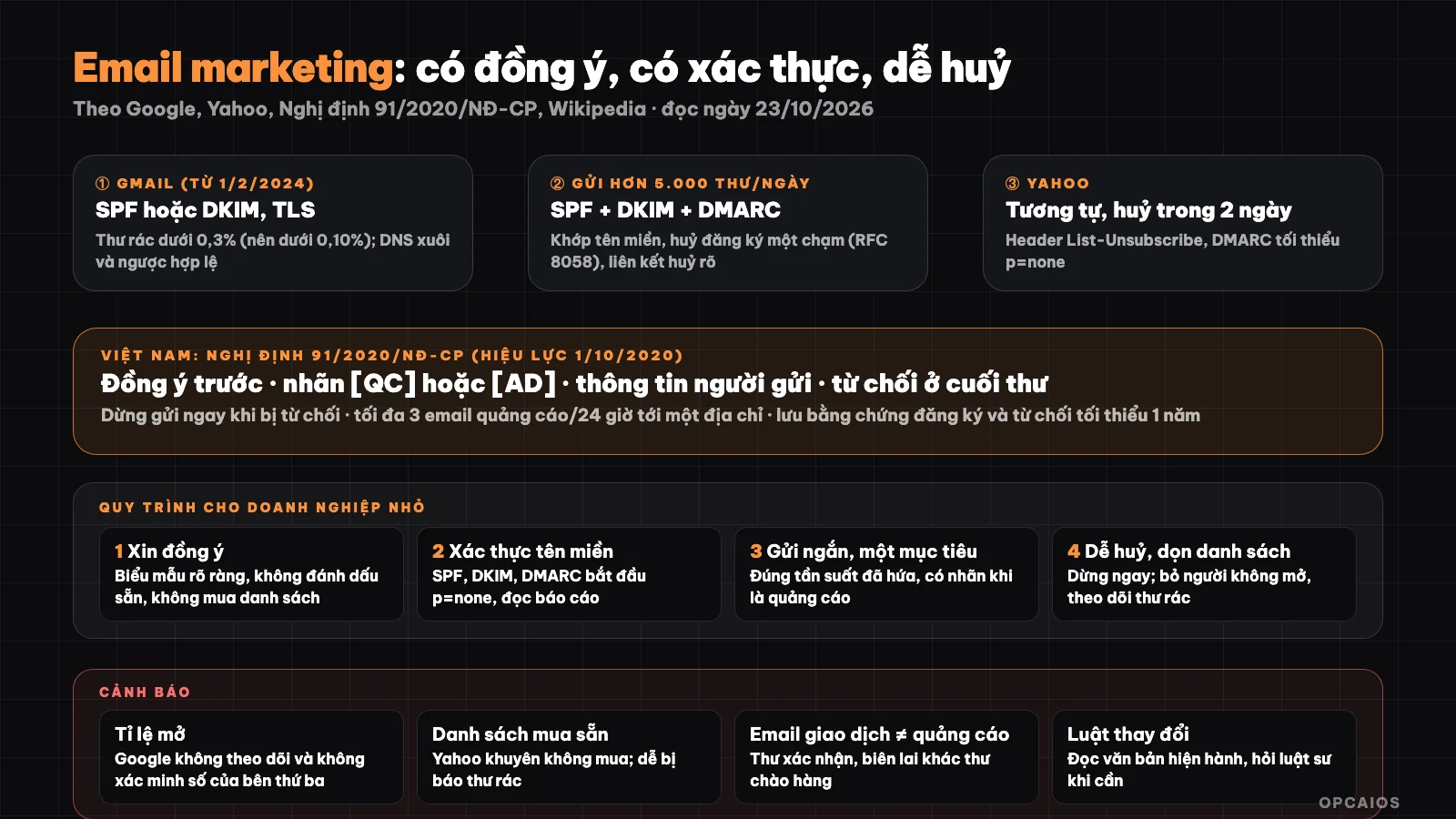
Thư vào được hộp thư đến cần ba lớp: có đồng ý của người nhận, xác thực tên miền, và huỷ đăng ký dễ dàng. Sơ đồ: OPCAIOS.
Email marketing là gì và có những loại nào?
Email marketing là hành động gửi thông điệp thương mại, thường tới một nhóm người, bằng email; theo Wikipedia (đọc ngày 23/10/2026), nghĩa rộng bao gồm quảng cáo, chào hàng hay kêu gọi quyên góp. Mục đích thường là tăng gắn bó với khách hiện tại và cũ, khuyến khích trung thành và mua lại, thu hút khách mới, hoặc thuyết phục mua ngay. Có ba loại phổ biến:
- Email giao dịch (transactional): gửi khi khách có hành động, như xác nhận đơn hàng, đặt lại mật khẩu, biên lai.
- Email trực tiếp (direct): chỉ để truyền tải thông điệp quảng bá, như ưu đãi hay danh mục sản phẩm.
- Bản tin và chuỗi chăm sóc: gửi định kỳ hoặc theo chuỗi sau khi khách đăng ký.
Ví dụ, thư xác nhận đơn hàng là email giao dịch, còn thư giới thiệu ưu đãi mùa lễ là email trực tiếp. Cùng mục tiêu gắn kết khách hàng, email marketing nằm trong bức tranh lớn của content marketing.
Điều kiện nào để email vào hộp thư đến của Gmail và Yahoo?
Từ 1/2/2024, đầu tiên, mọi người gửi email tới Gmail phải đáp ứng các yêu cầu cơ bản của Google, và người gửi hơn 5.000 thư mỗi ngày phải đáp ứng thêm. Theo trang "Email sender guidelines" của Google (đọc ngày 23/10/2026):
| Yêu cầu | Mọi người gửi | Gửi hơn 5.000 thư mỗi ngày |
|---|---|---|
| Xác thực | SPF hoặc DKIM | SPF, DKIM và DMARC (chính sách có thể là none) |
| DNS | Bản ghi DNS xuôi và ngược (PTR) hợp lệ | Như vậy |
| Kết nối | Dùng TLS | Như vậy |
| Tỉ lệ thư rác | Dưới 0,3% trong Postmaster Tools | Như vậy |
| Định dạng | Theo RFC 5322; không giả mạo From của Gmail | Như vậy, kèm khớp tên miền (alignment) với SPF hoặc DKIM |
| Huỷ đăng ký | Khuyến nghị | Bắt buộc huỷ một chạm và có liên kết huỷ rõ ràng trong thư |
Google khuyên giữ tỉ lệ thư rác dưới 0,10% và không bao giờ chạm 0,30% trở lên. Google cũng nói họ không theo dõi tỉ lệ mở và không kiểm chứng được tỉ lệ mở do bên thứ ba báo. Ngoài ra, hạn mức 5.000 thư mỗi ngày là mốc chia hai nhóm người gửi.
Yahoo yêu cầu gì với người gửi email?
Yahoo yêu cầu người gửi email xác thực tên miền, giữ tỉ lệ thư rác thấp và cho phép huỷ đăng ký dễ dàng, áp dụng từ tháng 2/2024 và triển khai dần. Theo hướng dẫn người gửi của Yahoo (đọc ngày 23/10/2026), yêu cầu tương tự Google. Mọi người gửi cần SPF hoặc DKIM, tỉ lệ thư rác dưới 0,3% và DNS xuôi ngược hợp lệ. Người gửi nhiều cần thêm ba điều:
- SPF cùng DKIM.
- DMARC tối thiểu p=none.
- Huỷ đăng ký một chạm qua header List-Unsubscribe; phương pháp POST theo RFC 8058 được khuyên dùng.
Ngoài ra, thư cần có liên kết huỷ rõ trong nội dung và việc huỷ phải được xử lý trong vòng 2 ngày. Ví dụ, một doanh nghiệp gửi 6.000 thư mỗi ngày tới Gmail thuộc nhóm người gửi nhiều, nên cần DMARC và huỷ một chạm theo cả Google và Yahoo. Yahoo cũng khuyên không mua danh sách và không đánh dấu sẵn ô đồng ý.
SPF, DKIM, DMARC, and One-Click Unsubscribe – What Do They Mean?
SPF, DKIM, DMARC, and one-click unsubscribe are four technical terms behind the requirements from Gmail and Yahoo, according to Google (read on 23/10/2026) and according to Yahoo. Specifically:
- SPF: a DNS record that declares which servers are allowed to send mail on behalf of your domain name.
- DKIM: a digital signature attached to the mail so that the recipient can check that the mail has not been altered and truly comes from your domain name.
- DMARC: a policy that tells the recipient what to do when SPF or DKIM does not match, along with reports sent back to you (the rua tag). The initial policy can be none, meaning just monitoring.
- One-Click Unsubscribe (RFC 8058): mail that has two headers
List-UnsubscribeandList-Unsubscribe-Post: List-Unsubscribe=One-Click. When the recipient clicks the unsubscribe button right in the mail application, your server receives a POST request and must process the unsubscribe.
Most email service providers (ESP) guide you through setting up SPF and DKIM for your sending domain. For example, before sending to Gmail, use your own domain instead of a free address, then verify the records using your provider's tools.
What Does Decree 91/2020/NĐ-CP Regulate About Advertising Email?
Decree 91/2020/NĐ-CP (effective from 1/10/2020, replacing Decree 90/2008 and 77/2012) is a document that regulates the sending of advertising messages, emails, and calls in Vietnam, according to Decree 91 (issued by the Government of Vietnam in 2020). For example, a store sending a promotion email must have prior consent and the label [QC] at the beginning of the subject line. Below are three main points about advertising email that we read directly from the document (read on 23/10/2026):
- Must have prior consent (Article 11): advertising mail may only be sent when the user has given prior consent, through methods such as declaration and confirmation in a registration form on the advertiser's website or social media. The advertiser must keep records of registration information, opt-out requests, and opt-out confirmations for at least 1 year.
- Must be labeled (Article 18): all advertising emails must have the label [QC] or [AD] in the first position of the subject line.
- Advertiser information (Article 19): includes name, telephone number, email address, geographic address, website or social media (if any), placed immediately before the opt-out section.
What Are the Opt-Out Function and Frequency Limits Under Decree 91?
Three remaining points, according to Decree 91 (read on 23/10/2026) and Articles 13, 17, 20, are the opt-out function, frequency limits, and content. For example, a sales email needs an opt-out function at the end of the mail.
- Opt-Out Function (Article 20): placed at the end of the mail and clear; the user has the right to opt out of all products from the advertiser, and when needed to opt out of individual products or groups. Forms of opt-out include through website or social media, by email, and by phone. Upon receiving a request, must send one confirmation message (containing no advertising) and stop sending.
- Frequency Limit (Article 13): do not send more than 3 advertising emails to one address in 24 hours, unless otherwise agreed.
- Content and Subject (Article 17): the subject must match the content, and the content must comply with advertising laws.
What Are Foreign Laws and Limitations of This Summary?
This is a summary for informational purposes, read from the 2020 document; the document may have been amended, so please check the currently effective text or consult a lawyer. For customers in other countries, there are separate laws: for example, according to the FTC (United States) regarding CAN-SPAM, which we only read through search excerpts, commercial email needs accurate header information, a subject line that does not mislead, a valid postal address, a clear opt-out method, and processing of opt-outs within 10 business days; please check the FTC website directly.
Email marketing process for small businesses
- Build a list with clear consent: signup form on your website with clear messaging about what people will receive and how often. Yahoo advises against buying lists and not pre-checking consent boxes.
- Confirm addresses before adding them: Google advises confirming each email address before subscribing, and periodically asking recipients if they want to keep receiving emails.
- Send what you promised: Yahoo reminds you not to switch weekly newsletter subscribers to daily emails.
- Set up domain authentication: SPF, DKIM, DMARC (start with p=none) before bulk sending; monitor reports.
- Write short emails with one goal: one call to action; label [AD] when it's advertising; sender info and unsubscribe link at the bottom.
- Make unsubscribing as easy as possible, and stop sending right away. Google says letting users stop receiving mail can improve open rates, click rates, and sending effectiveness.
- Measure the right things: spam complaint rate (Postmaster Tools), unsubscribe rate, click-through rate, conversions. Don't just look at open rate, because Google says it doesn't track and can't verify this number.
- Clean your list: Google advises considering removing people who don't open or read your emails.
Is it safe to use AI to write marketing emails?
AI helps draft quickly and test many variations, but rules about consent, ad labeling, truthful content, and unsubscribing don't change. Have someone review before bulk sending, check all numbers and promises, and keep brand voice consistent; see Vibe marketing là gì? on the risk of bland content, and n8n, Make, Zapier if you want to automate the sending process. If you need to keep customer lists and nurture history, see HubSpot là gì?.
OPCAIOS experience sending nurture emails
OPCAIOS uses an email nurture sequence in the admin area: send via a dedicated email service's SMTP server, with an unsubscribe link in each email, clickable links signed to prevent spoofing, track opens and clicks, and a private rejection list to avoid resending to people who unsubscribed. Each failed send is retried up to 3 times. We've also noted two gaps from best practices: the unsubscribe link is currently a confirmation page via GET, not supporting one-click unsubscribe by POST per RFC 8058; and the domain's DMARC policy is in monitoring mode (p=none). At our current sending scale, much lower than Google's 5,000 emails per day threshold, the stricter requirements for high-volume senders don't apply yet, but this is something we should improve before scaling up. We don't publish open or click rates in this post.
Read more: Building a paid newsletter business; The "Cold Outreach without spam" technique, 5 best email marketing tools 2026 for small shops.
Frequently Asked Questions
What is email marketing?
It is sending commercial messages via email, usually to a group of people, to nurture customers, encourage repeat purchases, attract new customers, or make sales.
What does Gmail require for email marketing?
From 1/2/2024: everyone sending needs SPF or DKIM, valid forward and reverse DNS, TLS, and a spam rate below 0.3%. Senders of more than 5,000 emails per day need to add DMARC, match the domain name, and have one-click unsubscribe with a clear link in the email.
What is required to send promotional email in Vietnam?
According to Decree 91/2020/NĐ-CP: you need prior consent from the recipient, mark [QC] or [AD] at the beginning of the subject line, include information about the advertiser, have an opt-out function at the end of the email and stop sending immediately upon rejection, and send no more than 3 promotional emails per day to one address unless otherwise agreed. Please check the current text and consult a lawyer.
Is open rate important?
Less than you think. Google says they do not track open rates and cannot verify numbers reported by third parties; spam rate, unsubscribe rate, click rate, and conversion rate are more reliable metrics.
Where do I start with email marketing?
Starting email marketing means building three foundational things before sending bulk emails. First, a signup form with clear consent, explaining what the recipient will receive and how often. Next, a sending domain with SPF and DKIM set up, then DMARC starting at p=none, following Google and Yahoo guidelines (read on 23/10/2026). Finally, a short welcome email with a clear unsubscribe link. For example, a small shop can collect addresses through a form on its website, send a welcome email, then only send a newsletter once a week as promised. For promotional email in Vietnam, remember to mark [QC] or [AD] according to Decree 91/2020/NĐ-CP. To learn how to build customer care workflows and automate them with AI, see OPCAIOS's AI application training course.
Sources: Google's "Email sender guidelines" page (Gmail Help) and Yahoo's sender guidance, read directly on 23/10/2026; Decree 91/2020/NĐ-CP (full PDF text) read directly Articles 11, 13, 17 to 20, 35; Wikipedia "Email marketing"; FTC information on CAN-SPAM obtained through search excerpts as the page did not load automatically. Configuration experience is from OPCAIOS. Not legal advice; laws and provider requirements may change.
Translated from Vietnamese with AI. Read the original.
Want to apply this in your business?
Book a free 30-minute call (Vietnam time, in English or Vietnamese).