


Supabase is an application development platform built around a Postgres database: each project is a full Postgres database, complete with user login, automatic API, file storage, real-time data, server-side functions, and vector search for AI. Thanks to this, one person or a small team can build the "backend" of a web or mobile application without having to assemble each service from scratch. According to Supabase's official pricing page (checked on 23/10/2026), the Free plan costs $0 per month and the Pro plan starts at $25 per month. Supabase is open source under the Apache-2.0 license and can be self-hosted on a private server. This post covers five main points: (1) Supabase components; (2) Row Level Security; (3) pricing; (4) how to get started; (5) self-hosting and connecting to AI, including OPCAIOS's practical experience.
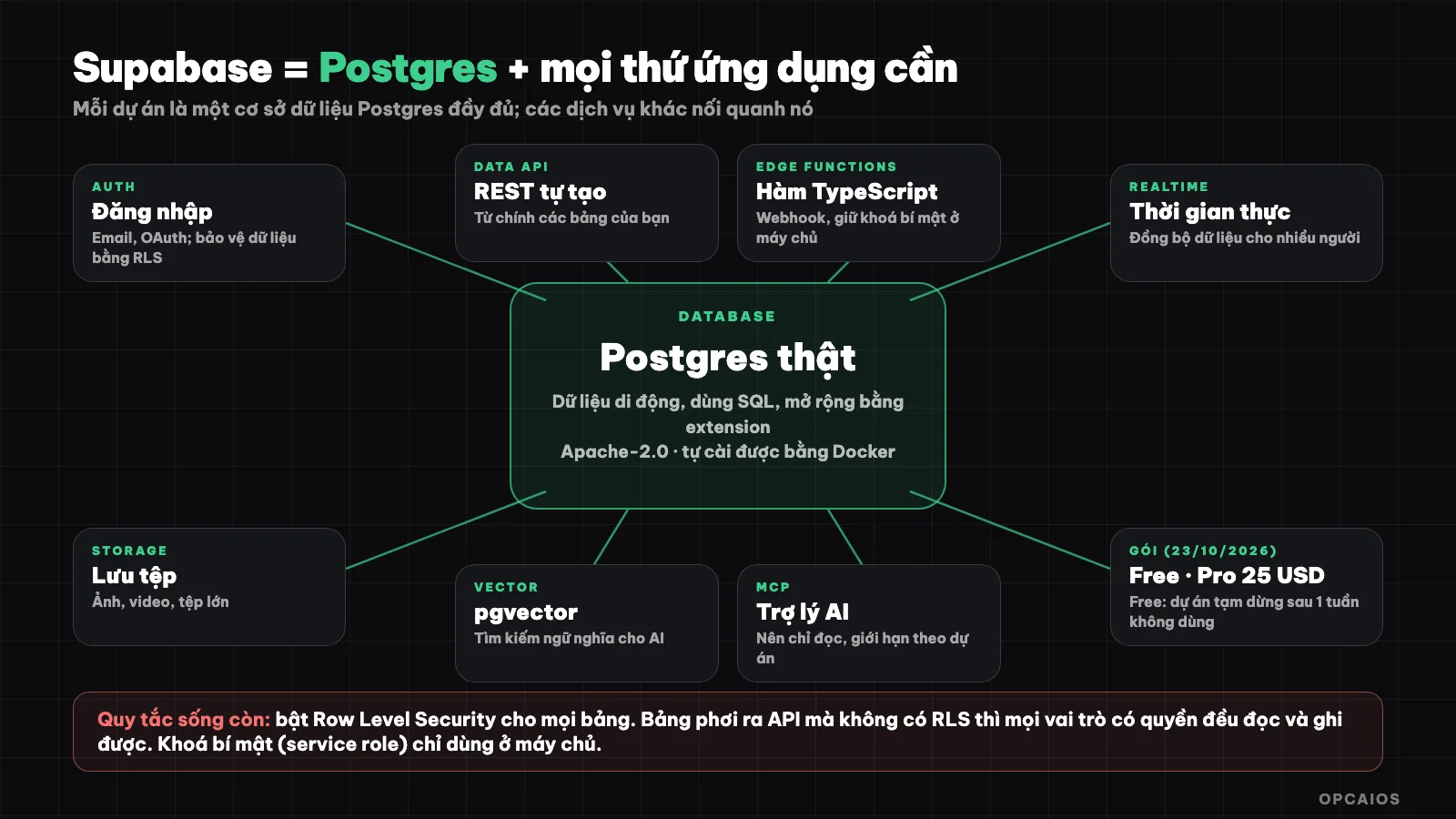
Supabase brings together the components of an application around a Postgres database. Diagram: OPCAIOS.
What is Supabase?
Supabase is a "Postgres development platform": instead of just giving you a database, the service adds components you typically need when building an application. According to the official homepage, you start with a Postgres database then add authentication, data API, Edge Functions, real-time data, file storage, and vector embeddings.
What makes Supabase different from many "ready-made backend" services is that your data sits in a real Postgres database, which means you can move your data elsewhere because it's standard Postgres; the Supabase homepage emphasizes 100% portability. According to GitHub (23/10/2026), the Supabase repository has around 113,500 stars, is licensed under Apache-2.0, and continues to be regularly updated. For example, imagine a small team building a customer management application could use Postgres, Auth, and the built-in API instead of assembling each service themselves.
What components does Supabase include?
Supabase consists of seven main components centered around a database. According to the official documentation:
| Component | What it does | Use example |
|---|---|---|
| Postgres database | Store relational data, extend with extensions | Customer and order tables |
| Authentication (Auth) | User signup, login, protect data with Row Level Security | Login with email, Google |
| Data API | Ready-made REST API from your tables | App reads and writes data |
| Edge Functions | TypeScript functions running server-side, near users (Deno-based) | Receive webhooks, call Stripe or AI |
| Realtime | Sync data in real-time | Chat, live leaderboards |
| Storage | Store and serve large files | Images, videos |
| Vector | Store and search vector embeddings (pgvector) | Semantic search for AI |
You use one, a few, or all of them. Many projects only use the database and authentication.
What is Row Level Security and why is it the most important?
Row Level Security (RLS) is a Postgres feature that lets you set permission rules running inside the database itself, deciding which rows each user can read and edit. This is where beginners most often make mistakes when using Supabase, because applications typically call the database directly from the browser.
The official documentation makes clear: a table in a schema exposed to the API without RLS enabled means every role with permissions on that table can read and write to it. Supabase's recommendation is to enable RLS on every table in the exposed schema, and remove default permissions for the anonymous role if your project still has it; adding policies alone does not remove those permissions.
Example: only let the creator view their own customers:
alter table khach_hang enable row level security;

create policy "chi_nguoi_tao_xem_duoc"
  on khach_hang for select
  to authenticated
  using ( (select auth.uid()) = nguoi_tao );
The key rule: enable RLS on every table, write minimal policies, then test with a regular user account, not with admin permissions. The "service role" key or secret key bypasses RLS, so only use it server-side and never expose it in the browser or public code.
What is Supabase pricing right now?
Supabase has a free plan and paid plans charged per project. According to Supabase's official pricing page (checked 23/10/2026), the Free plan costs $0 per month and includes unlimited API calls, 50,000 active monthly users, 500 MB database, and 1 GB file storage. The Pro plan starts at $25 per month and includes the first project, additional projects from $10 each, 100,000 active users, 8 GB disk, 250 GB bandwidth, 100 GB file storage, and daily backups retained for 7 days. The Team plan starts at $599 per month and adds SSO, backup controls, and industry compliance. The Enterprise plan is custom pricing.
Two important notes for the Free plan: projects pause after one week of inactivity and each account can have at most 2 active projects. So the Free plan works well for learning and testing, but not well for real applications that need to run continuously. Paid plans include $10 compute credits per month, enough for a Micro-sized machine, and the Pro plan has "spending limits" enabled by default to avoid surprise bills—you can disable it when you want to exceed the limit. Pricing changes over time, so check the official pricing page before deciding.
Detailed Supabase pricing table
| Plan | Price | Key points |
|---|---|---|
| Free | $0 per month | Unlimited API calls, 50,000 active monthly users, 500 MB database, shared CPU and 500 MB RAM, 5 GB egress bandwidth, 1 GB file storage |
| Pro | From $25 per month | First project included, additional projects from $10 each; 100,000 active users, 8 GB disk, 250 GB bandwidth, 100 GB file storage, daily backups retained for 7 days |
| Team | From $599 per month | Adds SSO, backup controls, and industry compliance |
| Enterprise | Contact | Dedicated support, uptime commitment |
How do I get started with Supabase in 30 minutes?
A first project goes through six steps, doable in about 30 minutes following the Supabase documentation and homepage (checked 23/10/2026). Example scenario: a customer table for a small shop can follow exactly this process, with under 100 test rows. The most important point is enabling RLS before importing real data, because skipping this step is the most common mistake for beginners.
- Step 1, create a project on Supabase and choose the region closest to your users.
- Step 2, create a table using the Table Editor or SQL Editor in the dashboard, for example a
khach_hangtable. - Step 3, enable RLS right away and add policies like the example above, before importing real data.
- Step 4, get the public key and project URL to connect from your application; keep the secret key only on the server.
- Step 5, call from your application using the official library. Example from Supabase homepage for a React app:
import { createClient } from '@supabase/supabase-js'

const supabase = createClient(process.env.SUPABASE_URL, process.env.SUPABASE_ANON_KEY)
const { data } = await supabase.from('todos').select('*')
- Step 6, add login with Auth so RLS policies know which user is calling.
If you're new to the concept of calling data through an API, read first What is an API?.
What are Edge Functions for?
Edge Functions are TypeScript functions that run server-side on Deno, distributed globally near users. According to Supabase documentation, they work well for receiving webhooks or integrating your project with third parties like Stripe. The Free plan includes 500,000 invocations per month (checked 23/10/2026).
Why use server-side functions instead of calling directly from the browser: secret keys for AI services or payment gateways should never be in code running in the browser. For example, OPCAIOS uses this exact approach for a custom application: the browser only calls the function, while the AI service key stays on the server. There are three simple steps. Step 1, the browser sends a request to the function. Step 2, the function reads the key from environment variables and calls the third-party service. Step 3, the function returns the result to the browser. If you need to receive events from another system, see the post What is a Webhook?.
Can You Self-Host Supabase on Your Own Server?
Yes. According to Supabase's official documentation (checked 23/10/2026), the quick and recommended way to self-host is using Docker Compose. This approach works when you need full control over your data, have compliance requirements that prohibit managed services, or want to run in an isolated environment.
You should know these differences beforehand: (1) the self-hosted version runs a single project, since Studio doesn't support multiple organizations or projects; (2) most settings are configured through environment variables; (3) some managed platform features are unavailable, like project branching, managed backups, point-in-time recovery (PITR), advanced metrics, and Management API. When self-hosting, you are responsible for security, updates, and backups.
This is OPCAIOS's real experience: the opcaios.org website runs its database on a self-hosted Supabase setup using Docker on our own server, including Postgres, Auth, API, Storage, Realtime, and Edge Functions. In exchange for full control over our data, we manage backups and upgrades ourselves.
How Does Supabase Connect with AI and AI Assistants?
Supabase connects with AI in two ways. First, the database supports vector embeddings through pgvector to store and search by meaning, which is the foundation for question-answering applications on private documents.
Second, Supabase has an MCP server so AI tools like Claude Code can interact with your project. According to Supabase's official documentation (checked 23/10/2026), you add it with the command claude mcp add --transport http supabase ... then log in through your browser, and can restrict the MCP server to one project or enable read-only mode. The documentation itself warns that connecting a language model to your Supabase project carries security risks, so read the security guide before running. General advice: use a development project, not real data; enable read-only mode and scope by project. Example scenario: a team tries MCP on a sample project with one table before connecting to customer data. See also What is MCP?.
How Does Supabase Differ from Airtable and Firebase?
Supabase suits developers who need a relational database and API; Airtable suits non-programmers who want a spreadsheet-like interface; Firebase uses document-based (NoSQL) database on Google infrastructure. Quick comparison table:
| Criterion | Supabase | Airtable | Firebase |
|---|---|---|---|
| Audience | Developers | Non-programmers | Mobile and web developers |
| Data Type | Relational (Postgres, SQL) | Relational, spreadsheet interface | Document format (NoSQL) |
| Self-hosting | Yes (Docker) | No | No |
| Strength | Data portability, SQL, RLS, open source | Build fast without code | Deep integration with Google ecosystem |
If you don't code and need fast data management, check What is Airtable?. If you lean toward documents and collaboration, see What is Notion?. Tool summaries are in the library: Supabase.
When Should and Shouldn't You Use Supabase?
Use Supabase when you need a real relational database, someone knows or is ready to learn SQL, you want data not locked into one vendor, and you need authentication, files, and real-time on one platform.
Don't use it when no one on your team codes (Airtable or Notion fit better), when you just need a one-person spreadsheet, or when you can't manage security. With Supabase, forgetting to enable RLS is a common and serious mistake, so someone needs to be responsible for reviewing policies before going public.
Read more: How to Build a Self-Learning AI Chatbot for Internal Documents (RAG) with Dify and Supabase.
Frequently Asked Questions
What is Supabase and what is it used for?
Supabase is an application development platform built around the Postgres database, with authentication, automatic API, file storage, real-time, Edge Functions and vectors. It's used to build the backend of a web or mobile application faster.
Is Supabase free?
Yes. According to Supabase's official pricing page (checked 23/10/2026), the Free plan costs $0 per month and includes a 500 MB database, 50,000 monthly active users, 1 GB file storage and unlimited API calls. Free projects are suspended after one week of inactivity, and each account can have a maximum of 2 active projects. So the Free plan is good for learning and trying, but less suitable for real applications that need to run continuously. The Pro plan starts at $25 per month, with 100,000 monthly active users and daily backups kept for 7 days. Pricing changes over time, so check the official pricing page.
Is Supabase open source?
Yes. The Supabase source code repository uses the Apache-2.0 license according to GitHub, and can be self-hosted using Docker. The self-hosted version lacks some features of the management platform such as managed backups and point-in-time recovery.
Is Row Level Security mandatory?
Not technically mandatory, but nearly mandatory for security: tables exposed to the API in a schema without RLS enabled can be read and written by any role with permissions. Enable RLS on all tables and test policies with a regular user account.
Where can I learn Supabase quickly?
Start with the official documentation and a small project like a to-do list with login. If you want to build data systems and AI processes for small businesses, check out OPCAIOS's AI application training course.
Source: Supabase official homepage, pricing page and documentation (database, Row Level Security, Edge Functions, self-hosted, MCP server; checked 23/10/2026) and GitHub supabase/supabase; OPCAIOS operational experience. Pricing and features may change.
Translated from Vietnamese with AI. Read the original.
Want to apply this in your business?
Book a free 30-minute call (Vietnam time, in English or Vietnamese).