

What is Salesforce?
Salesforce is a cloud-based CRM (customer relationship management) platform that includes applications for sales, customer service, marketing and e-commerce, plus a platform to customize and connect data. According to the official pricing page (checked on 23/10/2026), pricing starts at $25 per user per month for Starter Suite and goes up to $550 for the Max plan of Sales Cloud. This 2026 updated article follows four sections:
- What product lines does Salesforce include and how do the different pricing tiers differ.
- How to connect via REST API and real-time events using Pub/Sub API.
- Connecting with Claude (Anthropic) and ChatGPT through MCP servers.
- When a small business should choose Salesforce instead of simpler CRMs like HubSpot.
For example, a team of 10 users trying Starter Suite can get started without paying anything.
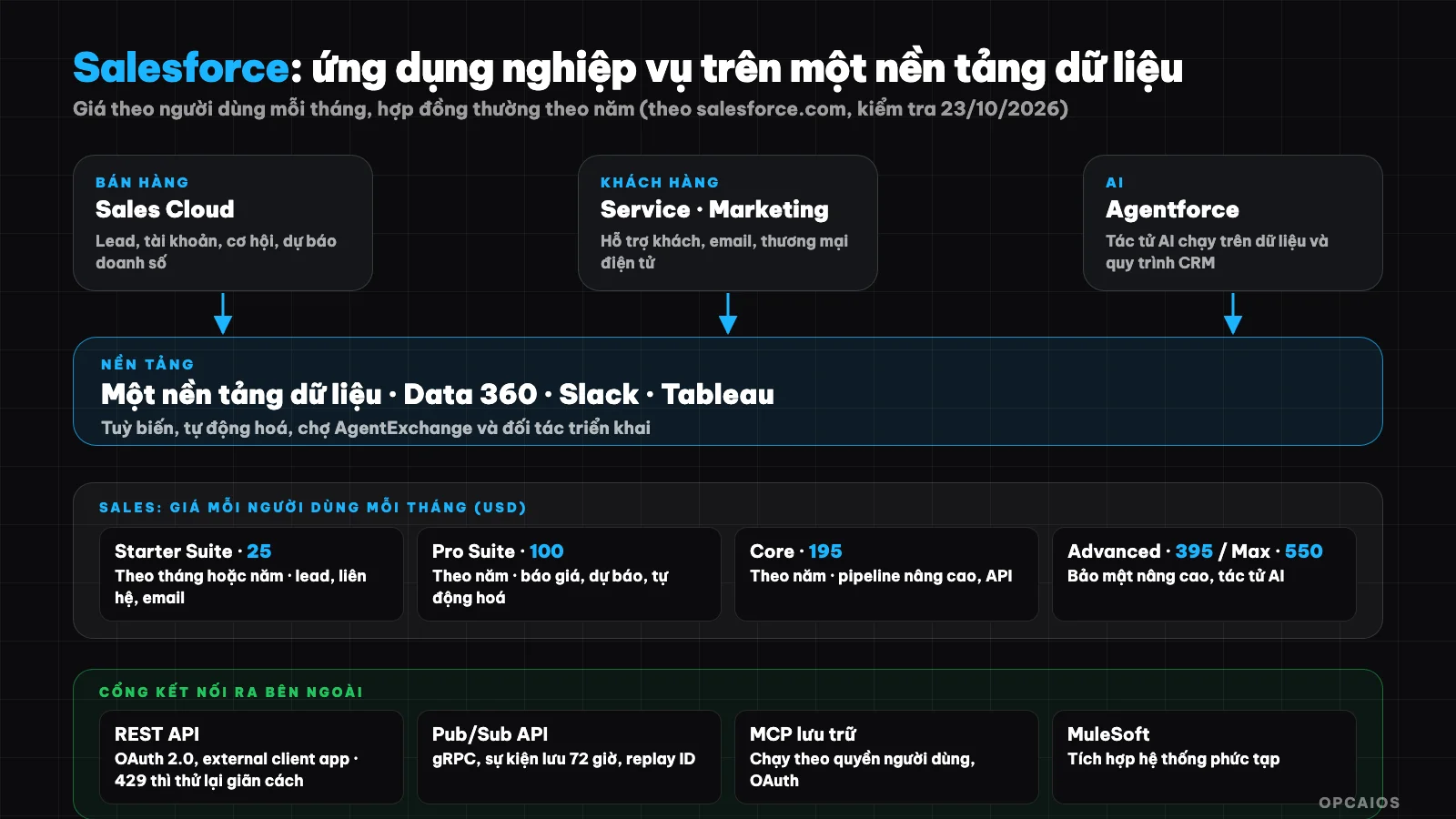
Salesforce consists of business applications on a shared data platform, sold per-user pricing tiers. Diagram: OPCAIOS.
What is Salesforce?
Salesforce is an enterprise software platform on a subscription model, where CRM is the core. CRM is a database that stores all information about customers and sales opportunities for the team to use together. The homepage describes itself as "AI CRM" bringing people, AI agents and data onto a single platform.
Common product lines from the homepage and pricing page:
| Product Line | Used for |
|---|---|
| Sales Cloud | Managing leads, accounts, opportunities, sales forecasting |
| Starter Suite and Pro Suite | Lean CRM for small business, including sales, service, marketing, commerce |
| Service | Customer care and support |
| Marketing and Commerce | Email marketing, online sales |
| Agentforce | AI agents running on Salesforce data and processes |
| Data 360 | Merging data from multiple sources |
| Slack, Tableau | Collaboration and analytics, bundled with some plans |
| MuleSoft, Heroku | System integration and application platform |
| AgentExchange | Marketplace of apps and agents from partners (formerly AppExchange) |
What are Salesforce Sales plans and pricing?
Salesforce Sales pricing is five plans per user per month, divided by scale. According to the official Sales pricing page (checked on 23/10/2026), Starter Suite $25 (monthly or yearly), Pro Suite $100, Core (Sales Cloud) $195, Advanced $395 and Max $550, plans from Pro Suite billed yearly. Highlights by plan:
- Starter Suite: manage leads, accounts, contacts, opportunities; built-in sales pipeline; email marketing.
- Pro Suite: add customization, automation, quotes, forecasting and AgentExchange access.
- Core: advanced pipeline, opportunity scoring, API, Slack Business+, Tableau Next.
- Advanced and Max: advanced security, AI agents and top Sales Cloud benefits.
Add-on products are priced separately: Agentforce for Sales from $125, Sales Programs from $100, Revenue Intelligence from $220, Revenue Cloud from $200 per user per month, and Partner Relationship Management from $10 per login per month. The plan comparison table also notes API access is an additional $25 per user per month on some plans. For example, a team of 5 on Pro Suite costs around 5 × $100 = $500 per month before add-ons, billed yearly. Check the comparison table before buying.
The pricing page notes most products use yearly contracts, Sales Cloud has a free 30-day trial (Starter Suite trial for up to 10 users), and prices are for reference only; see the official pricing page for your region.
When should a small business choose Salesforce?
A small business should choose Salesforce when it needs complex sales processes and is ready to invest in configuration and training. The Starter Suite package ($25 per user per month, according to the official pricing page checked on 23/10/2026) makes Salesforce more accessible to small teams, but costs grow quickly with higher tiers and more users. There are three situations to consider:
- Need serious forecasting and pipeline management: many stages, multiple teams, reporting by region or product.
- Need deep customization and a large ecosystem: access to the AppExchange marketplace and many implementation partners.
- Already have or will soon have many systems: need integration via API, events, MuleSoft.
For example, a company with 30 salespeople organized by region and product fits Salesforce better than a shop with 3 people. Conversely, if you only need basic customer and pipeline tracking, a CRM with a free tier or built on existing data might be sufficient and cheaper; see the comparison in the post What is HubSpot?.
How do you connect Salesforce via API?
Salesforce has a REST API to read and write data from external systems. According to the developer documentation, the authentication process is typically OAuth 2.0 through an external client app: you enable OAuth settings for the app, use the app's key and secret to get an access token from the /services/oauth2/token endpoint, then send that token in the Authorization header in subsequent requests. For server-to-server integration you can use the client credentials flow; this flow does not return a refresh token, so when the token expires the client requests a new one.
Key points to remember about limits and error handling:
- Organization-wide limits: the number of API requests per 24 hours depends on your edition and license type. Call the
limitsendpoint to see your remaining quota. - Status 429: means you sent too many requests in a short time; the documentation recommends retrying with exponential backoff.
- Save the access token: reuse it until it expires rather than requesting a new one for each request.
If you're new to the concept, read What is an API?. Note: Salesforce's documentation pages block automated access, so the technical details in this section have been cross-checked against official documentation excerpts; please verify specific numbers in the documentation for your organization's edition.
How does Salesforce report real-time events?
Instead of simple webhooks, Salesforce uses Pub/Sub API to publish and subscribe to events, including platform events and change data capture (CDC, events that report when a record changes). Four main points, according to Salesforce (developer documentation, checked on 23/10/2026), are:
- Technology: Pub/Sub API uses gRPC and HTTP/2, with messages in binary Avro format.
- Channels: for example the CDC channel for all entities is
/data/ChangeEvents, while custom events take the form/event/EventName__e. - Storage and replay: platform event and CDC messages are kept for 72 hours on the bus; each message has a replay ID so you can read from a specific point.
- Flow control: the client chooses how many events it wants to receive per call to match its processing speed.
For a small business, this is a more reliable way to report "a record just changed" than constant polling. The processing pattern remains: remember your last processed position, guard against duplicate processing, retry with backoff; see What is a Webhook?. If you want to connect Salesforce to an automation tool, using n8n, Make, or Zapier is a common approach.
How does Salesforce connect with AI through MCP?
Salesforce has hosted MCP servers, allowing AI agents to access Salesforce data. According to the official announcement (April 2026), this feature has been released broadly to organizations from Enterprise Edition and up, and Developer Edition is free. There are two types:
- Standard servers: record operations (create, read, update, delete), SOQL queries, search, plus servers for Data 360 and Tableau.
- Custom servers: built in API Catalog, can expose Apex actions, Lightning Flows, Apex REST endpoints and named queries.
Access runs under the permissions of the logged-in user, authenticated via OAuth through an external client app (documentation notes not using Connected App for MCP authentication). Tested clients include Claude (Anthropic), ChatGPT, Cursor and Postman, per Salesforce documentation. Like any other MCP: start with read permissions, test in a sandbox, and keep manual review before write operations; see What is MCP?. Feature status changes over time, so check the current documentation.
Things to note before buying Salesforce
- Calculate total cost: price per user times number of users and months, plus add-ons, plus setup and training costs. Contracts are usually annual.
- Start from process: describe the steps from lead to payment before choosing a plan.
- Clean data: standardize how names are written, customer sources from day one so reporting and AI can work with it.
- Personal data: CRM contains customers' personal information; collect only what's necessary, control access by role and follow current data protection rules.
- Try before paying: use the 30-day trial with your team's real data.
- OPCAIOS experience: opcaios.org does not use Salesforce but built its own CRM in the same database (customer intake, work and processing deadline, payment, customer source, Zalo and Messenger inboxes), because order and bank transfer payment data already lived in the website. That's a choice for OPCAIOS's scale and process, not a general recommendation.
Read more: Best CRM for small business 2026.
Frequently asked questions
What is Salesforce?
Salesforce is a cloud CRM platform comprising sales, customer service, marketing, ecommerce and data platform apps, with built-in AI and Agentforce agents, sold by user per plan.
How much does Salesforce cost?
Per the official Sales pricing page (23/10/2026): Starter Suite $25, Pro Suite $100, Core $195, Advanced $395, Max $550 per user per month. Add-ons billed separately and contracts are usually annual.
Does Salesforce have a free trial?
Yes. The pricing page offers a free 30-day trial of Sales Cloud, and Starter Suite trial for up to 10 users. Salesforce has no permanent free CRM plan like some competitors.
How does Salesforce connect with AI and other systems?
Via REST API with OAuth 2.0, Pub/Sub API for real-time events, MuleSoft for complex integrations and hosted MCP servers for AI agents to access data under user permissions.
Should small business use Salesforce?
Small business should use Salesforce if it needs complex sales processes, deep customization and partner ecosystem; Starter Suite at $25 per user per month is the entry point. If needs are simple, compare HubSpot's free plan or a DIY CRM. Per Salesforce's pricing page (checked 23/10/2026), Sales Cloud has a free 30-day trial, so the practical way is to try with your team's real data before signing a year contract. First, sketch your process from lead to payment. Next, count how many users actually need it. Last, compare total monthly cost with a simpler CRM. Want to build customer flows and automate, see OPCAIOS's AI application training course.
Source: homepage, Sales pricing page and CRM page of Salesforce (checked 23/10/2026); developer documentation (REST API, Pub/Sub API, Hosted MCP Servers) cross-checked via excerpts because developer.salesforce.com blocks automated access. Prices, limits and features may change; support level for customers in Vietnam not yet checked.
Translated from Vietnamese with AI. Read the original.
Want to apply this in your business?
Book a free 30-minute call (Vietnam time, in English or Vietnamese).