

What is Vibe Coding?
Vibe coding is the way to build software by describing it in natural language to an AI code-writing model, then testing it and asking AI to fix it further, without carefully reading each line of generated code. The term was coined by Andrej Karpathy (OpenAI co-founder, former head of AI at Tesla) in a post on X on February 2, 2025, and was chosen by Collins Dictionary as Word of the Year 2025. The 2026 update post comprises four parts:
- Karpathy's original definition and how it differs from AI-assisted programming.
- When vibe coding is and is not suitable.
- Risks with data, from Veracode's report to incidents at Lovable and Replit.
- A disciplined process that real product teams can apply using Claude Code (Anthropic).
For example, a UI mockup tested in one afternoon suits vibe coding, but a payment page does not.
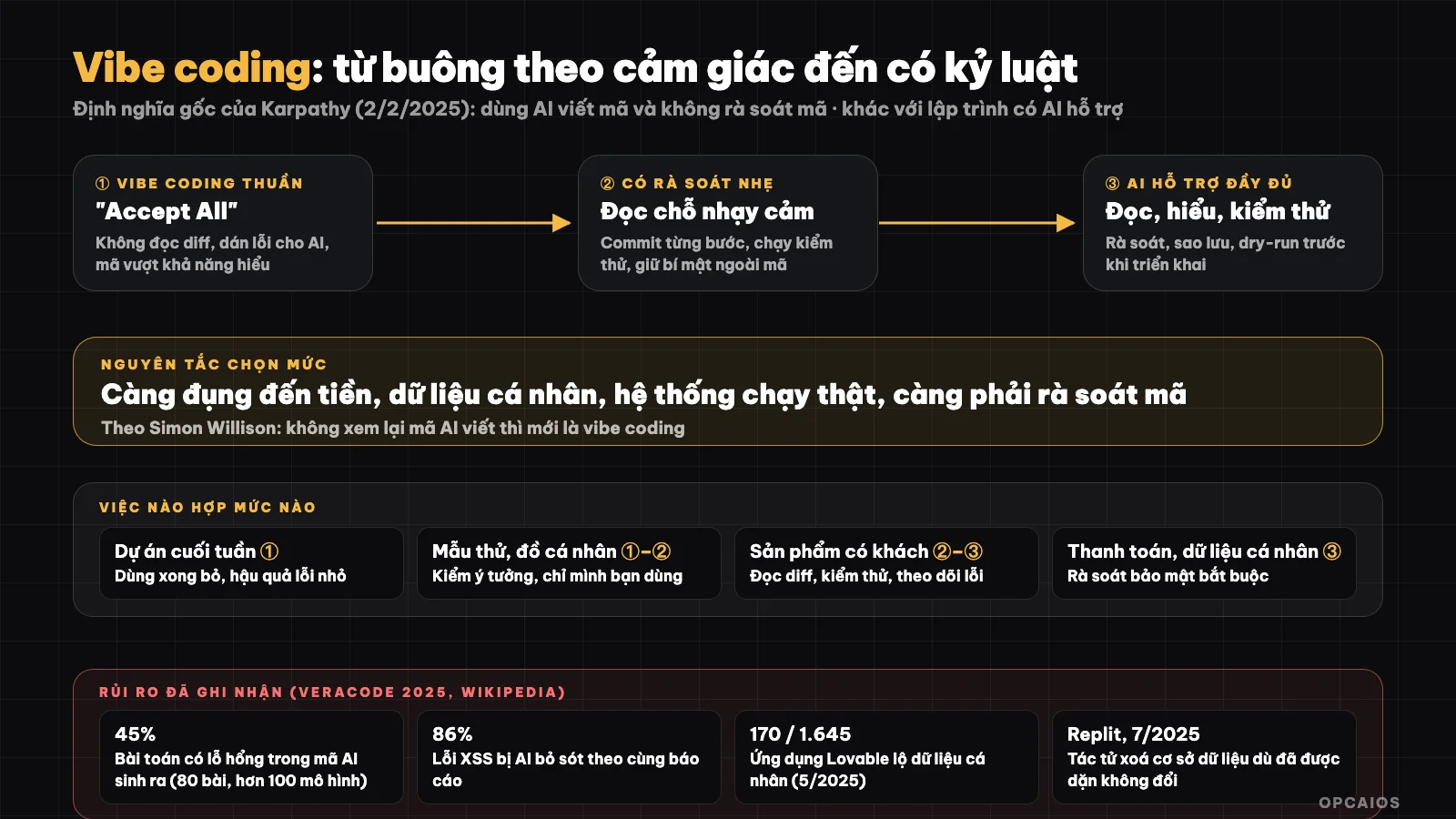
The more you touch money, personal data, and running systems, the more you must review code. Diagram: OPCAIOS.
What is Vibe Coding?
According to Karpathy's original post, vibe coding is "a new kind of programming" where you "completely go with the feeling, accept exponential speed gains, and forget that source code exists". He describes his own approach: talking to the assistant in the editor via voice so he almost never touches the keyboard; asking for small things like "reduce the sidebar padding by half"; always hitting "Accept All" and never reading diffs anymore; when bugs happen, pasting the entire error message without comment. The code is "beyond his normal comprehension ability", and he concludes this is a way "not bad for weekend projects you throw away when done, but still quite interesting".
What conditions does the original definition have?
The original definition has two conditions: using AI to write code, and not reviewing the code. According to Wikipedia, Merriam-Webster added this term to "slang and trending" as of March 2025, and Collins chose it as Word of the Year 2025 (the Collins page blocks automated access so we relied on news reports and Wikipedia). Collins defines vibe coding as using AI prompted in natural language to assist in writing computer code. Karpathy's original post had over 7.3 million views according to X data (checked October 23, 2026). For example, using Cursor (the tool Karpathy mentioned) to create an intro page then hitting "Accept All" fits the original definition.
How Does Vibe Coding Differ From AI-Assisted Programming?
Vibe coding differs from AI-assisted programming in whether you read, understand, and take responsibility for the code. Programmer Simon Willison, in "Not all AI-assisted programming is vibe coding" (March 19, 2025, read October 23, 2026), emphasizes this distinction: vibe coding is building software using a language model without reviewing the written code. He worries the term is being used for all kinds of AI-powered coding, watering down the meaning and creating a false impression of what can be done responsibly. There are two main points of distinction:
- AI-assisted programming: you read, test, and understand the result, and per Willison that is not vibe coding.
- Pure vibe coding: you accept results by feel, for example using Cursor to create a page then hitting "Accept All".
The table below compares five criteria:
| Criteria | Vibe coding (original definition) | AI-assisted programming |
|---|---|---|
| Read diff and understand code | Don't read, "Accept All" | Read, understand, edit |
| Handle errors | Paste error to AI, try until it works | Find root cause, write tests |
| Take responsibility for code | You accept the result by feel | You own every line |
| Suitable for | Trial projects, mockups, weekend toys | Real products, running systems |
| Main risk | Vulnerabilities, unmaintainable code | Lower if review is thorough |
What does a typical vibe coding workflow look like?
The process is usually a short loop: describe what you want, let AI write it, run it, then paste the result or error back to AI to fix. The tools Karpathy mentioned are Cursor Composer running the Sonnet model and SuperWhisper voice input; nowadays many people use agents like Claude Code or Codex, or app-building platforms like Lovable and Replit (according to Wikipedia). Common thread: the maker mostly "looks, speaks, runs and pastes" instead of writing syntax.
This loop is incredibly fast for when you need an interface, a small script or a prototype to see if an idea is worth doing. It loses its edge when the code has grown so large that no one understands it, because when AI gets stuck, you no longer have enough knowledge to guide it.
When should and shouldn't you vibe code?
You should vibe code when the cost of small errors is low and code can be thrown away; you shouldn't when one mistake means losing money, losing data or exposing user information. According to Simon Willison (3/19/2025), the line lies in whether you review the code or not. First, three fitting cases:
- Prototypes to test ideas and interfaces, weekend projects, tools only you use.
- One-time scripts to transfer or clean unimportant data, then throw away.
- Learning: watch AI solve a problem, then read it to understand.
Next are three cases you shouldn't, or at least must review carefully:
- Login, permissions, payments, invoices. See how to handle them safely in What is a Webhook? and What is Stripe?.
- Anywhere storing customer personal data. With databases, understand row-level access control (RLS) in What is Supabase? before opening to real users.
- Systems running for customers and deployment operations.
For example, asking Claude (Anthropic) to build a test landing page is reasonable; asking it to fix payment calculation code means you need to read every line.
Are there numbers on vibe coding risks?
Vibe coding risks fall into three recognized groups: security vulnerabilities, AI agent incidents, and hard-to-maintain code. The first group has the clearest data. The Veracode GenAI Code Security 2025 report (published 7/30/2025) notes that, according to Veracode, the research team analyzed 80 selected coding problems across over 100 large language models and recorded three findings:
- Code generated by AI has security vulnerabilities in 45% of cases.
- When choosing between safe and unsafe approaches, models pick the unsafe way 45% of the time, and security effectiveness doesn't improve over time even though syntactically correct code increases.
- AI misses 86% of cross-site scripting (XSS) injection errors.
Note: the 45% figure applies to problems in the study, not all code AI writes, and the report is published by a security solutions vendor. For example, a login page written by AI still needs someone to review it before opening to customers.
What incidents have happened when giving AI authority?
Three examples are recorded, according to Wikipedia (compiled from press sources, checked 10/23/2026) and under the "Vibe coding" section (Wikipedia):
- App leaking data. In May 2025, the app-building platform Lovable was reported to have a flaw in generated code: 170 out of 1,645 web apps created by Lovable had errors allowing anyone to access personal information.
- Agent breaking the system. In July 2025, the SaaStr founder documented how Replit's AI agent deleted a database despite being explicitly told not to change anything.
- Hard-to-maintain code. Karpathy himself admits code "larger than normal comprehension"; for whoever maintains it later, that's technical debt.
The first two examples come from Wikipedia so take them as illustrations, not general statistics about all vibe coding products.
How to do vibe coding with discipline
Vibe coding with discipline is a way to keep the speed of AI but put back the guardrails that "Accept All" lost. The first four habits below are OPCAIOS's real experience using Claude Code (Anthropic) to build websites, and align, according to Simon Willison (19/3/2025), with the spirit of distinguishing vibe coding:
- Write the request first: a short summary of the goal, limits, and what not to touch; AI does well when there are rules, as in AI writes code wrong version.
- Do small steps, with git: each change one commit so you can go back. With a shared repo, only commit the files you fixed.
- Read diff in sensitive places: login, permissions, payment, handling personal data, everything that touches the database.
- Have automated tests and checks: so AI runs them and reads the results instead of trusting the "done" report.
For example, before asking AI to fix the payment page, write clearly in the request that the price config file must not be touched.
How should secrets, permissions, and backups be handled?
The next four habits protect real data and running systems, from OPCAIOS's experience:
- Keep secrets outside the code: API keys and passwords go in environment variables, never paste them into prompts or code running in the browser.
- Grant minimum permissions: if the agent only needs read, don't give write; if you need to connect tools, see What is MCP? on the principle of least privilege.
- Back up before letting the agent touch real data, and test every destructive action on a test environment.
- Dry-run before deployment and check the build result: a real lesson of ours on 23/10/2026: one deployment using
rsync --deletefrom a local copy deleted a file that another session had just added on the server, breaking the build (the website still ran the old version thanks to the zero-downtime switch mechanism). Since then we always pull the latest, dry-run with--dry-runto see if there are anydeletinglines, then deploy.
Choosing the model also matters: hard tasks, many files need a strong model; small work can use a cheaper model. See Which AI model should I pick?.
Can someone who doesn't know programming do vibe coding?
Yes, with small products and for yourself. Wikipedia notes that supporters say vibe coding helps amateur programmers create software without long software engineering training, while critics worry about lack of accountability, hard maintenance, and security risks. A practical way is to make a prototype with vibe coding to test the idea, then if you want to give it to real customers, ask someone with expertise to audit security, or learn enough to audit yourself. The kind of work to hand to experts or check most carefully is login, payment, and personal data.
Read more: Claude Code (or programming agents) for people who don't know code; Guide to using Cursor AI and Lovable to build Micro-SaaS/Landing Page without knowing code.
Frequently Asked Questions
What is vibe coding?
It's a way of making software by describing what you want in natural language to an AI that writes code, then running it and asking the AI to fix it, without carefully reading the code. The term was coined by Andrej Karpathy on 2/2/2025 and is Collins' Word of the Year 2025.
How is vibe coding different from AI-assisted programming?
Vibe coding by its original definition means not reviewing the code the AI writes. AI-assisted programming is when the programmer reads, tests and understands the code, then takes responsibility for it.
Is vibe coding safe?
Not automatically. According to the Veracode 2025 report, code written by AI had security vulnerabilities in 45% of the problems tested, and security effectiveness did not improve over time. For anything involving login, payment or personal data, you need to review the code.
When should I use vibe coding?
When the consequences of errors are small and the code can be thrown away: prototypes, weekend projects, personal tools. Don't use pure vibe coding for production systems with money or customer data.
How do I use AI to write code for a real product?
Keep the speed of AI but add clear requirements, commit step by step, read diffs in sensitive places, have tests, keep secrets out of the code, backup and test before deploying. If you want to learn this process, see OPCAIOS's AI application training course.
Sources: original post by Andrej Karpathy on X (2/2/2025); "Not all AI-assisted programming is vibe coding" by Simon Willison (19/3/2025); press release for Veracode's GenAI Code Security 2025 report (30/7/2025); Wikipedia "Vibe coding" (Collins, Merriam-Webster, Lovable and Replit incidents, compiled from press sources; checked 23/10/2026); Collins blocks automated access so information about Word of the Year is based on news reports. The process experience is from OPCAIOS. Numbers may change over time.
Translated from Vietnamese with AI. Read the original.
Want to apply this in your business?
Book a free 30-minute call (Vietnam time, in English or Vietnamese).